Headsets Down: How the Metaverse Bet Burned Hollywood — and Where Immersive Entertainment Actually Landed
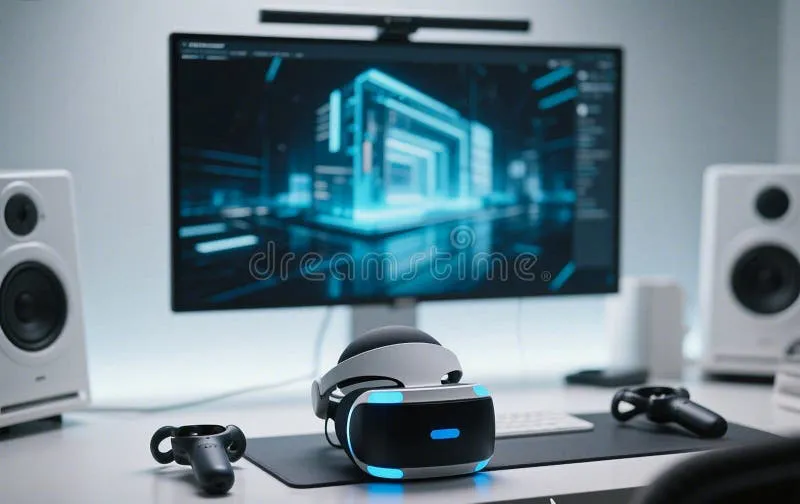
Photo: abandoned VR headset on desk next to laptop streaming entertainment, via thumbs.dreamstime.com
There was a moment — somewhere around late 2022, bleeding into 2023 — when it felt like every major studio, streaming platform, and tech conglomerate had the same pitch deck. Slide three always looked the same: a person in a VR headset, arms outstretched, surrounded by floating logos. The metaverse was going to change everything. Movies wouldn't just be watched; they'd be inhabited. Concerts wouldn't just be streamed; they'd be experienced. Entertainment, we were told, was about to become fully dimensional.
It didn't quite work out that way.
The Billion-Dollar Shrug
Meta — the company that literally renamed itself after the concept — lost over $40 billion on its Reality Labs division between 2022 and 2024, with precious little mainstream adoption to show for it. Disney quietly dismantled its metaverse division in early 2023, laying off the team it had assembled just months before. Warner Bros. Discovery shelved several high-profile VR tie-in projects. Even Fortnite's ambitious push into live virtual concerts, which genuinely wowed people during the Travis Scott event in 2020, struggled to recapture that lightning in a bottle at scale.
The pattern was consistent: enormous investment, splashy announcements, underwhelming audience response.
So what actually happened?
The Hardware Problem Nobody Wanted to Talk About
Here's the uncomfortable truth that got buried under all the hype: most Americans still don't own a VR headset, and the ones who do don't wear them for more than a few minutes at a time. According to Pew Research data from 2023, only about 13% of U.S. adults had ever used a VR headset — and "ever used" is doing a lot of heavy lifting in that statistic. Regular use? Far lower.
Building an entertainment ecosystem around hardware that lives in a closet was always going to be a problem. Hollywood has a long history of betting on formats before the infrastructure catches up — remember 3D TV? — but the metaverse push felt particularly disconnected from how real people actually consume content. Families aren't gathering around a shared headset the way they once gathered around a television set. The social layer that made the metaverse concept compelling on paper evaporated in living rooms across the country.
There's also the comfort issue. Extended VR sessions still cause enough discomfort for enough users that "lean back and enjoy" — the fundamental promise of entertainment — gets undermined almost immediately.
What the Hype Got Wrong About "Immersion"
Perhaps the biggest miscalculation was definitional. The metaverse crowd conflated immersion with enclosure — the idea that surrounding someone in a digital environment automatically creates a more engaging experience. But immersion, as any novelist or filmmaker will tell you, is fundamentally about emotional investment. You can feel completely absorbed by a two-inch phone screen if the story is pulling you in. You can feel completely detached inside a 360-degree VR environment if there's nothing emotionally at stake.
The most immersive entertainment experiences of the past two years had almost nothing to do with headsets.
The Stuff That's Actually Working
While VR was stumbling, a quieter revolution was happening at the intersection of gaming, streaming, and interactive design — and it's producing experiences that feel genuinely new.
Gaming as narrative infrastructure. Games like Alan Wake 2 and Baldur's Gate 3 demonstrated that the most sophisticated storytelling happening anywhere in entertainment right now is inside games. These aren't just "cinematic" games in the old sense of pretty cutscenes stitched between gameplay. They're works where player agency and narrative consequence are genuinely intertwined. Larian Studios didn't need a headset to make players feel like they were inside the story.
Streaming's location-aware experiments. A handful of streaming platforms have been quietly testing features that blend content with real-world context — think localized horror experiences tied to actual geographic data, or companion apps that add ambient sound layers to match your environment. It's subtle, but it gestures toward something interesting: immersion that works with how people already watch, rather than asking them to change their behavior entirely.
Theme park and physical-digital hybrids. Universal and Disney (ironically) have found more traction with physical experiences that incorporate digital layers than with pure virtual ones. The integration of app-based interactivity into theme park rides and environments — where the physical sensation grounds the digital overlay — turns out to be a more intuitive proposition for audiences than strapping on a headset at home.
The Lesson for Storytellers
None of this means VR is dead forever. The technology is genuinely improving, headset prices are slowly dropping, and there are specific use cases — certain types of documentary work, therapeutic applications, location-based entertainment venues — where the format earns its keep.
But for the entertainment industry broadly, the metaverse era delivered a useful, if expensive, lesson: audiences don't chase technology. They chase stories. The formats that win are the ones that lower the barrier to emotional connection, not raise it.
Immersive storytelling is very much alive in 2024. It just looks a lot more like a great game you can't put down or a streaming series that makes you forget what time it is — and a lot less like a press release with a cartoon avatar in it.