Blurred Lines: The Rise of Fake Docs, Dramatized Truth, and Why Streaming Can't Stop Messing With Your Head
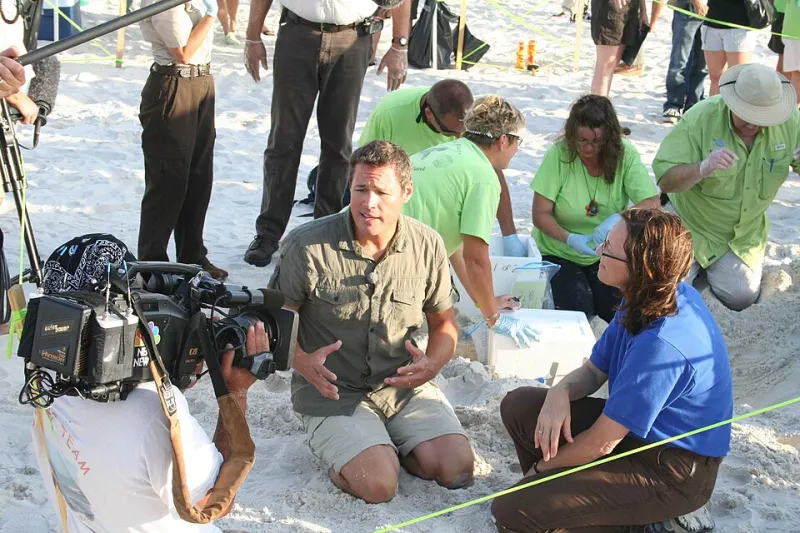
Photo: Maxfield Barbara, U.S. Fish and Wildlife Service, Public domain, via Wikimedia Commons
Somewhere between The Office and American Murder: The Family Next Door, a format war quietly got won — and most of us didn't notice until we were already confused about what we'd just watched.
The documentary aesthetic has taken over entertainment. Not just mockumentaries, which have been around forever, but something stranger and more pervasive: a whole spectrum of content that looks like a documentary, feels like journalism, and may or may not have a meaningful relationship with actual events. And streaming platforms are absolutely thriving on the ambiguity.
The Spectrum Is Wider Than You Think
Let's map this out, because the "fake doc" label covers a lot of ground.
At one end, you've got classic mockumentaries — This Is Spinal Tap, Best in Show, Abbott Elementary — where the joke is the format itself. Everyone knows it's fiction. The handheld camera and the talking-head interviews are a wink to the audience.
Then there are shows like The Office or Parks and Recreation, which use the mockumentary structure more as a narrative device than a punchline. Still clearly fiction. Still comfortable.
But then you get into murkier territory. Netflix's The Tinder Swindler is a real documentary — but it reconstructs scenes with the actual participants re-enacting their own memories. Inventing Anna is a drama about a real person, with a disclaimer that reads "this story is completely true except for the parts that are totally made up." That's not a joke. That's the actual disclaimer. American Crime Story dramatizes real cases with actors but frames itself with the gravity of journalism. And now, with AI tools making it trivially easy to generate realistic-looking footage of things that never happened, the far end of this spectrum is getting genuinely unsettling.
Why Does It Work So Well?
The short answer: authenticity is the most powerful currency in contemporary media, and the documentary aesthetic is a delivery mechanism for it.
When you see shaky handheld footage, when you see someone speaking directly to the camera in a sparse room, when you see lower-thirds with names and titles — your brain reads those signals as real. It's a conditioned response built over decades of watching actual documentaries and news programs. Filmmakers and content creators know this, and they use it.
There's also something deeper happening. Audiences are increasingly skeptical of polished, produced content. Overly slick advertising, perfectly lit Instagram posts, studio-approved press junket interviews — people have developed a pretty sharp radar for performative authenticity. The rough-around-the-edges documentary look bypasses that radar. It signals "this wasn't constructed for you," even when it very much was.
The Blair Witch Project understood this in 1999. What's different now is scale — this technique has migrated from horror movies to docuseries to branded content to political messaging, and the tools to execute it have never been cheaper or more accessible.
The True Crime Problem
Nowhere is the ethics of this more fraught than in the true crime space, which has become the dominant genre on streaming and one of the most aggressive adopters of dramatized reality.
Shows like Monster: The Jeffrey Dahmer Story generated enormous viewership and enormous backlash, particularly from the families of victims who felt the dramatization was exploitative. The Netflix series used actors to portray real people — real grieving families — in scenes that were imagined rather than documented. The show was presented with the weight and seriousness of a documentary, which made the fictional elements feel like a violation rather than a creative choice.
This is the central ethical tension: when you borrow the credibility of documentary filmmaking to tell a story, you implicitly claim a truthfulness you may not be entitled to. Audiences watch differently. They believe differently. And when the subject matter involves real victims and real families, the stakes of that belief are much higher than they are for a fake rock band in Spinal Tap.
Platforms have largely responded to this criticism by adding disclaimers — sometimes prominently, sometimes buried. Whether that's sufficient is a question the industry hasn't really answered yet.
The AI Wrinkle
All of this gets significantly more complicated with the arrival of AI-generated content that can fabricate realistic-looking footage, voices, and imagery.
We've already seen early examples of this being used in entertainment contexts — deepfake-adjacent technology used to de-age actors, to recreate deceased performers, to generate "archival" footage that doesn't exist. The technology is moving faster than any regulatory or ethical framework for it.
Imagine a docuseries that presents AI-generated "behind-the-scenes" footage of a historical event — realistic, convincing, clearly labeled somewhere in the fine print as reconstructed. How many viewers read the fine print? How does that footage circulate on social media, stripped of its context? These aren't hypothetical concerns. They're already happening at the edges, and they'll be mainstream concerns within a few years.
The Creators Playing It Straight (and the Ones Playing Games)
Not everyone working in this space is being cynical about it. Some creators are genuinely exploring what the documentary format can do when it's freed from the obligation to be literally true.
Nathan Fielder's The Rehearsal on HBO is maybe the most interesting recent example — a show that is technically a documentary (Fielder is playing himself, the situations are real) but that deliberately destabilizes every assumption you bring to that label. It's uncomfortable in ways that are clearly intentional and intellectually serious. It makes you think about performance, authenticity, and the ethics of documentary filmmaking itself.
That's the high end of what this format can do. The low end is a true crime docuseries that dramatizes a murder for shock value and calls it journalism.
So How Should You Watch?
Here's an honest answer: with a little more skepticism than the format invites.
The documentary aesthetic is a powerful tool, and like any powerful tool, it can be used well or badly. The shaky camera and the talking-head interview don't make something true — they make something feel true, which is a different thing entirely. Streaming platforms have strong financial incentives to keep that distinction fuzzy, because fuzzy is more compelling than clearly labeled fiction.
That doesn't mean you can't enjoy Inventing Anna or get genuinely moved by a dramatized true crime series. It means keeping one part of your brain engaged with the question of what you're actually watching, and why it's been constructed to feel the way it does.
The most immersive storytelling formats are always the ones that make you forget you're in a constructed experience. The fake documentary has gotten very, very good at exactly that — and the least we can do is notice.